Over the centuries, there have been many discussions, questions, and even arguments about the Three Wise Men who attended the birth of Christ, such as; did they actually attend His birth, or did they arrive as many as two years after that event, when He was a child? Who were they? Whence did they come? How did they know about the advent of Christ? Were they Persian, Babylonian, or Zoroastrian astronomers, perhaps? And if Zoroastrian - did Zoroaster himself learn of the prophecy of the coming of Christ from the Hebrew prophet Daniel, as some believe? Or were the Three Wise Men Chinese, as the Chinese - and many others - claim?
And, in modern times, the arguments continue - did the Three Wise Men even exist, or is the whole tale just a Christian fable?
Well, I frankly don't care. In fact, for the purpose of this post, I will not address any of the traditions, questions, or doubts that attend the tale of the Three Wise Men. For; I know in my heart that they lived and that they saw the Christ Child. And that is what matters to me.
They came from somewhere to the east, in that vast landscape of Asia that stretches from the Middle East to the Pacific Ocean. It had been understood by most of the eastern cultures for several, perhaps many, centuries that the King of the Universe would someday come down and be born upon earth, as a man, specifically, as a Jew. They knew that a special never-before-seen star was to herald his birth. The Three, like generations of wise men before them, diligently watched the sky for the sign of the advent of the King, hoping against hope that they, in their generation, would be the ones fortunate enough to witness the marvelous event.
And one day - or night - there it was.
Unique, bright, like nothing else in the heavens, it hung low in the western sky.
They had no doubt of its significance.
Their hearts bursting, their minds alive with anticipation, the Three loaded up their camels, gathered their servants, accumulated supplies for a long journey, and set out toward the west, following the Star, seeking a King. And, at the end of two years, they found Him. Astounded and awed by their immense good fortune, they presented their gifts, worshiped Him, and then, being warned by an angel of God of Herod's deadly animus toward the new-born King, they avoided the Israelite usurper and "went home by another way."
But they took with them an amazing gift; they had seen the King of Kings, born upon earth as a man.
Now, Jesus Christ is variously described as the Son of God, the Son of Humanity, a prophet, a kind and gentle Teacher, a Healer, the Savior. And He is, of course, all of those things and more.
But I see Him, first and foremost, as the Wise Men saw Him - the King of all.
I was raised by Godly parents, good Christian people who taught me to live by His teachings. I read the Bible completely through as a young man, many parts of it I read more than once and studied much of it diligently. I even memorized at one time or another several passages of scripture. Even so, I never had that deeper experience to which so many spiritual folk bear witness.
For me, for much of my life, belief was based not so much upon spiritual experience as it was upon intellectual reasoning. It was faith founded upon the pragmatic underpinnings of knowledge and of all that I had learned about the various belief systems of humanity.
In the year 1986 I found myself living in an extremely rural part of Tennessee with a wife and four young children, and I experienced a startling, and rather abrupt comprehension that being a parent was not just about providing food, shelter, and clothing. I needed to understand the meaning of human existence if I was to impart anything meaningful to my three daughters and my son.
So I set to work, educating myself on the subject of the Great Question; Why Are We Here? Learning what I could of every theory about the existence of life on earth - and I mean every theory - I eventually dismissed all of them except the Bible. But all my dismissals, at the time, were based solely on rational thought, and upon those things which I had discovered of each theory or religion, not on any particular spiritual experience.
Understand: I am not touting myself as an authority on anything, especially religion. I do not care what anyone else chooses to believe, and I long ago passed the point where any human can claim influence with me as it concerns the most basic questions of existence.
By late summer of 1987, I had decided in a rather cold intellectual sense that Jesus Christ was the answer, and that His teachings were the way to understanding. So, I read the New Testament once again, this time as if I was reading it for the first time, without any preconceived notion of what any of it meant. And I found that it satisfied, in a purely logical sense, all my questions.
But I wanted more. I wanted empirical evidence of my Maker.
Then I happened upon a very old book called Deeper Experiences of Famous Christians. Admittedly I was skeptical of many of the things expounded inside that book; nonetheless, after reading it, I craved an experience of my own - a personal meeting with God.
To that end, I made my way one day out across the field behind the house, down through the hollow and into the forest beyond. Searching through the woods, I found a small clearing with a large rock jutting from the ground near its center like an altar. I knelt and prayed. After praying for some time, it occurred to me that, rather than yammering in God's ear; it would benefit me more to listen.
So, I listened. And I heard - nothing.
After that day, and for every single day thereafter, in all kinds of weather, every evening after work, I went faithfully into the woods to that little clearing, knelt down, and told God simply; I am here.
Nothing. Ever. Nothing. I never heard His voice. There was never any kind of sign.
Through all those days, while awaiting a sign from the heavens, I read the New Testament again. And yet again. I spent an hour every day alone in the forest, listening. Days turned into weeks, weeks became months. After eight months of this, summer had cooled into autumn, autumn became winter, winter turned into yet another spring. And I had had no experience.
I grew discouraged. Discouragement eventually devolved into a sort of rebellious anger. But, in fact, something had happened to me over this time period which had nothing to do with my earlier studies. Nor was it related to any experience. It was, in a very real way, miraculous. The words of Jesus had passed through my eyes, worked their way through my brain, and had settled in my heart.
I knew now, without any doubt, that I was a created being. I knew that God created me. And I knew that Jesus Christ was His Son. I knew now the reason I - or any of us - exist.
So, then - I wondered rather petulantly - why didn't He speak to me?
One fine spring evening in 1988, I had finished my supper and was about to make my way, once again, into the woods behind the house. But as I went out the front door and onto the porch, the rebellious anger erupted.
I am done with this, I thought. It is pointless. He will never speak to me.
Turning the other way, I abandoned any thought of going to my "altar" and I tromped down the lane toward the bridge over the creek. As I walked on, and on, through the dappled sunlight that cast long shadows across the lane, my dark mood gradually lifted and after a while I began to quietly laugh at myself. Who did I think I was, anyway? In the great scheme of things, I would barely qualify as a worm; likely something even less. Why then would The Almighty feel compelled to speak to me? He would not, of course. For in a vast universe of humble servants, I suddenly realized, I was among the humblest; perhaps the humblest of all.
I stopped on the bridge, gazed down into the sparkling stream, and smiled to myself. The dark mood, its attendant anger, and the weight of needing to hear the Voice of God were gone. As was the need for an experience.
I was abruptly and rather acutely aware of the warm spring evening and all the life it contained within it, all of it a testimony to the Creator of life. Birds chirped in the thickets, wildflowers burst through the ground along the creek, the heady scent of honeysuckle filled the air. The earth itself was bearing witness to its Maker.
Never again would I need to go into the forest, find an altar, seek a sign. Every day of being alive was in and of itself an experience, a sign. Nothing else was - or would ever be - necessary. At last content, I turned toward the house.
And then, right then; when I expected - and needed - it least, He was there.
Right there.
With me, on the bridge.
Did I see Him? No. Did I hear an audible Voice? No.
Yet He was there. And He was there for me.
I have never related the details of that moment to anyone; nor will I ever do so. It is meaningful only to me, is highly personal, and it can have no bearing whatsoever on anyone else in their striving after God.
Over the years, I have referred to it privately as my Three Wise Men Moment. For in that moment, upon that bridge, I, far less wise than they, far less clever, far less deserving, was given a great gift that has sustained me throughout my life.
I often find myself distracted by the cares of this life: the need to make money, the frustration with the contemporary state of politics, the anger over man's inhumanity to his fellow man that is daily seen, the worry over this or that or some other thing. And I more often than not forget that which matters most - that which, in fact, alone truly matters; living a life that pleases the King.
I lose my way.
So then, every so often, I must push the world aside and go back in time to that moment on the bridge, to touch that moment, to remember it and its meaning. To remember what really matters.
Then, my priorities properly restored, my mind and my heart lifted, my feet back upon the right path, then, and only then, can I get on with my life "by another way."
Merry Christmas.
Daniel Hylton is the author of the Kelven's Riddle fantasy series.

Showing posts with label Dad's guest post. Show all posts
Showing posts with label Dad's guest post. Show all posts
Wednesday, December 16, 2015


Monday, December 1, 2014
Ghost of Behavior Past by Daniel Hylton
Throughout the late '70s and into the early '80s, while my marriage was new and my children were young, I worked for a large Southeastern construction company.
I was good at my job and I made a lot of money. A lot of money - especially for those years. There were times when I would have two or three thousand dollars worth of un-cashed checks in my wallet.
By 1984, however, I had apparently tired of being successful and making prodigious sums of money. I wanted something less.
I decided to leave my high-paying job constructing transcontinental power lines and try my hand at - of all things - songwriting. So, I moved to rural Tennessee, about an hour west of Nashville. Now, because one needs free time to pursue songwriting, it is very difficult to maintain steady employment. As a consequence of this fact, I odd-jobbed, taking temporary work where I could find it, gradually descending into poverty, dragging my young wife and children with me. (Why Karen did not leave me for a man with a job and a fully functioning brain, taking the children with her, I will never fully understand.)
Desperate to combine my inexplicable need to be creative with my obviously explicable need for cash, I began to enter the various songwriting contests hosted by the nightspots around Nashville.
And I won a few, sometimes winning ten or twenty dollars, enough for milk, bread, and maybe a pair of shoes for one of the little ones. Usually, though, the prize was something insubstantial, such as getting your name written on the wall in magic marker, or a free bottle of beer.
Then I heard about this contest on Music Row itself, at a more upscale joint called The Dive.
The winner would get one hundred dollars.
One Hundred Dollars!
Now, I know that doesn't sound like much now, but back then a hundred bucks paid for most of a month's rent or bought groceries for the family for a whole week. And the contest, at the time, was being held weekly, so there would be a continuing chance to win.
On the appointed night, I put on my best pair of dark blue Levis, my crispest white shirt, tuned up my guitar, and headed into town to The Dive.
There were a lot of really good songwriters present that night, and I heard many tunes that made me think I might be way out of my league. I was so nervous that my bladder sent me scurrying to the men's room again and again. Nonetheless, when they called my name, I screwed up my courage and went up on stage which was occupied by just a stool and a mike. I sat down with my guitar on my knee and spun to face the crowd. For a moment, I thought they'd all left the building. You see, though the stage was fully lit, the patrons sat in the dimness beyond the footlights - and the lights shining on me were so bright that I could barely make out the room, let alone individuals in the crowd, which was the largest group of people that I had ever confronted when armed only with a musical instrument.
I mumbled something by way of introduction and immediately swung into my first song, briskly setting pick to guitar string.
I looked out, opened my mouth -
- and forgot the words to the song. A song which I wrote.
There followed then a long - way too long - awkward pause while, like the proverbial deer, I gazed into the headlights of oncoming disaster and frantically searched the dark recesses of my skull for phrases that I recognized and might possibly utter in tune-like fashion while strumming a guitar.
And then, as the disapproving silence thickened, the words finally came.
"Alrighty, folks," I stated brightly, affecting what I hoped would be a magnificent recovery, and once again put pick to string. "Here we go....."
One strum, and - Boing! - the pick slipped from my fingers, ricocheted underneath the strings, and disappeared through the sound hole into the dark interior of my guitar. I looked down, stunned.
And my brain froze.
Forgetting in that terrible moment that there were two or three spare picks in my pocket, and sadly forgetting that there were also a couple of hundred people immediately to my front, I upended the guitar, holding it aloft, shaking it above my head while I desperately tried to dislodge the pick from the black hole whence it had gone.
Sporadic chuckles arose here and there from among the crowd as I continued to wildly agitate the instrument over my head, willing the pick to appear. Then, as my struggles continued unabated and my hope for a rescued pick remained unrealized, more chuckles, giggles, and outright laughter swelled from the shadowed gathering.
That awful collection of sound caused my brain to lurch forward for one brief moment. And in that moment, I remembered the extra picks in my pants pocket. Turning a deaf ear to the scattered giggles and the occasional rude suggestion, I thought bravely - I can still salvage this.
Lowering the guitar to one side, holding it by the neck, I stood, reaching into my pocket.
And the room erupted.
Gales of laughter beat upon me like the waves of a storm-wracked ocean.
Puzzled by the reason for this obvious - and horrifying escalation - of my humiliation, I stared dumbly out at the shadowy crowd for a long moment; and then I looked down.
And the reason for the raucous shouts of laughter became immediately obvious.
Evidently, on my last trip to the men's room, I had neglected to zip up the fly in my blue jeans.
Protruding from that most private of all clothing apertures, extending stiffly outward for five or six inches, was the crisply starched tail of my best white shirt.
The crowd, by that time, had decided that I was not in fact a contestant, but rather the comedic relief.
I, in that same moment, decided that I was done, finished, my short-lived "career" over.
Turning, I fairly leapt from the stage and ran for it, pausing in the artists' room just long enough to sling my guitar into its case, and then I bounded for the side door. I was running like a rabbit by the time I reached the parking lot.
Three-quarters of an hour later, utterly dejected, having had forty-five long, miserable minutes to ponder one of the most embarrassing evenings of my life, I pulled into the driveway of our modest home. Karen met me at the door. I could do nothing but stand there, head down, guitar case in hand, my heart and my dreams squashed like insects upon the walkways of life.
"How did it go?" She asked - and then I managed lift my head and she saw my face. "Honey - what happened?"
The kids were in bed, so I put my guitar away while she made us a cup of cocoa; then we went into the living room and sat down on the couch, where I stared down at the carpet and glumly related to her the events of the evening.
It was about the time that I was telling of the unzipped fly and protruding shirt-tail that I heard the stifled guffaw emanating from the general direction of the love of my life.
Startled, I looked over at her.
You know how it is when you want to laugh but know that you shouldn't? Like when you're at a wedding, or at a funeral, or in church, or like when your beloved husband is laying out the sad details of his recent and raw humiliation, and something just strikes you as too funny? And the eruption of good humor is abruptly way too urgent to contain or suppress?
You get a terrible case of the internal giggles, your shoulders shake, the corners of your mouth decide that they simply must turn upward despite your best efforts at maintaining decorum, and your eyes water. Yeah, we all know what that is like. It has happened to us all.
Well, that was my gentle and genteel wife as I told my tale of woe.
Apparently, she could see the whole thing very clearly with her mind's eye.
She tried to be sympathetic, God bless her; she really did try.
Alas, the droll aspect of the whole sordid affair was too much for her, and eventually she had to gain release. To this day, however, I am not convinced that it was absolutely necessary it devolve into her lying back against the cushions, gasping for breath as she pointed at me and giggled uncontrollably. The only consolation I have is that - though she won't admit it - I'm pretty sure she wet herself.
Oh, well.
There is an epilogue to this sorry tale. Two, actually.
A week later, I tapped a reservoir of courage, went back to The Dive, sang my three songs - and won. And they had raised the stakes. First prize was now one hundred and fifty bucks. The next day, to celebrate, we took the kids to McDonalds for Happy Meals.
The second epilogue is not quite so uplifting as the first, at least for me. You see, every now and then - as recently as just the other day, in fact - I will find Karen leaning over a counter or sprawled over the back of a chair, fairly convulsing with good humor. Looking up at me with streaming eyes, she will tender the question between eruptions of giggles.
"Remember that time you went into Nashville to sing in that contest?"
Yes. Yes, I do.
And it's still not funny.
One doesn't require ghosts, I guess, when one is haunted by his past.
Daniel Hylton is the author of the recently completed Kelven's Riddle series.
I was good at my job and I made a lot of money. A lot of money - especially for those years. There were times when I would have two or three thousand dollars worth of un-cashed checks in my wallet.
By 1984, however, I had apparently tired of being successful and making prodigious sums of money. I wanted something less.
I decided to leave my high-paying job constructing transcontinental power lines and try my hand at - of all things - songwriting. So, I moved to rural Tennessee, about an hour west of Nashville. Now, because one needs free time to pursue songwriting, it is very difficult to maintain steady employment. As a consequence of this fact, I odd-jobbed, taking temporary work where I could find it, gradually descending into poverty, dragging my young wife and children with me. (Why Karen did not leave me for a man with a job and a fully functioning brain, taking the children with her, I will never fully understand.)
Desperate to combine my inexplicable need to be creative with my obviously explicable need for cash, I began to enter the various songwriting contests hosted by the nightspots around Nashville.
And I won a few, sometimes winning ten or twenty dollars, enough for milk, bread, and maybe a pair of shoes for one of the little ones. Usually, though, the prize was something insubstantial, such as getting your name written on the wall in magic marker, or a free bottle of beer.
Then I heard about this contest on Music Row itself, at a more upscale joint called The Dive.
The winner would get one hundred dollars.
One Hundred Dollars!
Now, I know that doesn't sound like much now, but back then a hundred bucks paid for most of a month's rent or bought groceries for the family for a whole week. And the contest, at the time, was being held weekly, so there would be a continuing chance to win.
On the appointed night, I put on my best pair of dark blue Levis, my crispest white shirt, tuned up my guitar, and headed into town to The Dive.
There were a lot of really good songwriters present that night, and I heard many tunes that made me think I might be way out of my league. I was so nervous that my bladder sent me scurrying to the men's room again and again. Nonetheless, when they called my name, I screwed up my courage and went up on stage which was occupied by just a stool and a mike. I sat down with my guitar on my knee and spun to face the crowd. For a moment, I thought they'd all left the building. You see, though the stage was fully lit, the patrons sat in the dimness beyond the footlights - and the lights shining on me were so bright that I could barely make out the room, let alone individuals in the crowd, which was the largest group of people that I had ever confronted when armed only with a musical instrument.
I mumbled something by way of introduction and immediately swung into my first song, briskly setting pick to guitar string.
I looked out, opened my mouth -
- and forgot the words to the song. A song which I wrote.
There followed then a long - way too long - awkward pause while, like the proverbial deer, I gazed into the headlights of oncoming disaster and frantically searched the dark recesses of my skull for phrases that I recognized and might possibly utter in tune-like fashion while strumming a guitar.
And then, as the disapproving silence thickened, the words finally came.
"Alrighty, folks," I stated brightly, affecting what I hoped would be a magnificent recovery, and once again put pick to string. "Here we go....."
One strum, and - Boing! - the pick slipped from my fingers, ricocheted underneath the strings, and disappeared through the sound hole into the dark interior of my guitar. I looked down, stunned.
And my brain froze.
Forgetting in that terrible moment that there were two or three spare picks in my pocket, and sadly forgetting that there were also a couple of hundred people immediately to my front, I upended the guitar, holding it aloft, shaking it above my head while I desperately tried to dislodge the pick from the black hole whence it had gone.
Sporadic chuckles arose here and there from among the crowd as I continued to wildly agitate the instrument over my head, willing the pick to appear. Then, as my struggles continued unabated and my hope for a rescued pick remained unrealized, more chuckles, giggles, and outright laughter swelled from the shadowed gathering.
That awful collection of sound caused my brain to lurch forward for one brief moment. And in that moment, I remembered the extra picks in my pants pocket. Turning a deaf ear to the scattered giggles and the occasional rude suggestion, I thought bravely - I can still salvage this.
Lowering the guitar to one side, holding it by the neck, I stood, reaching into my pocket.
And the room erupted.
Gales of laughter beat upon me like the waves of a storm-wracked ocean.
Puzzled by the reason for this obvious - and horrifying escalation - of my humiliation, I stared dumbly out at the shadowy crowd for a long moment; and then I looked down.
And the reason for the raucous shouts of laughter became immediately obvious.
Evidently, on my last trip to the men's room, I had neglected to zip up the fly in my blue jeans.
Protruding from that most private of all clothing apertures, extending stiffly outward for five or six inches, was the crisply starched tail of my best white shirt.
The crowd, by that time, had decided that I was not in fact a contestant, but rather the comedic relief.
I, in that same moment, decided that I was done, finished, my short-lived "career" over.
Turning, I fairly leapt from the stage and ran for it, pausing in the artists' room just long enough to sling my guitar into its case, and then I bounded for the side door. I was running like a rabbit by the time I reached the parking lot.
Three-quarters of an hour later, utterly dejected, having had forty-five long, miserable minutes to ponder one of the most embarrassing evenings of my life, I pulled into the driveway of our modest home. Karen met me at the door. I could do nothing but stand there, head down, guitar case in hand, my heart and my dreams squashed like insects upon the walkways of life.
"How did it go?" She asked - and then I managed lift my head and she saw my face. "Honey - what happened?"
The kids were in bed, so I put my guitar away while she made us a cup of cocoa; then we went into the living room and sat down on the couch, where I stared down at the carpet and glumly related to her the events of the evening.
It was about the time that I was telling of the unzipped fly and protruding shirt-tail that I heard the stifled guffaw emanating from the general direction of the love of my life.
Startled, I looked over at her.
You know how it is when you want to laugh but know that you shouldn't? Like when you're at a wedding, or at a funeral, or in church, or like when your beloved husband is laying out the sad details of his recent and raw humiliation, and something just strikes you as too funny? And the eruption of good humor is abruptly way too urgent to contain or suppress?
You get a terrible case of the internal giggles, your shoulders shake, the corners of your mouth decide that they simply must turn upward despite your best efforts at maintaining decorum, and your eyes water. Yeah, we all know what that is like. It has happened to us all.
Well, that was my gentle and genteel wife as I told my tale of woe.
Apparently, she could see the whole thing very clearly with her mind's eye.
She tried to be sympathetic, God bless her; she really did try.
Alas, the droll aspect of the whole sordid affair was too much for her, and eventually she had to gain release. To this day, however, I am not convinced that it was absolutely necessary it devolve into her lying back against the cushions, gasping for breath as she pointed at me and giggled uncontrollably. The only consolation I have is that - though she won't admit it - I'm pretty sure she wet herself.
Oh, well.
There is an epilogue to this sorry tale. Two, actually.
A week later, I tapped a reservoir of courage, went back to The Dive, sang my three songs - and won. And they had raised the stakes. First prize was now one hundred and fifty bucks. The next day, to celebrate, we took the kids to McDonalds for Happy Meals.
The second epilogue is not quite so uplifting as the first, at least for me. You see, every now and then - as recently as just the other day, in fact - I will find Karen leaning over a counter or sprawled over the back of a chair, fairly convulsing with good humor. Looking up at me with streaming eyes, she will tender the question between eruptions of giggles.
"Remember that time you went into Nashville to sing in that contest?"
Yes. Yes, I do.
And it's still not funny.
One doesn't require ghosts, I guess, when one is haunted by his past.
Daniel Hylton is the author of the recently completed Kelven's Riddle series.
Thursday, October 23, 2014
Losing It In Tandem
Guest post by Daniel T Hylton
I am shocked - shocked! - to know that I am sixty years old. And my lovely wife, though she doesn't look it, is fifty-nine, for crying out loud.
Wasn't it just last week that we were teen-aged lovers, standing beneath the lilacs in front of her father's house, stealing kisses as her brothers made the porch light flicker?
Alas - no, we are no longer so young. But, really; how did sixty get here so fast?
This year, I was made to know my age, like it or not. Back in March, three days before my sixtieth birthday, I was squatting down, watching my grandson play a game on his bedroom floor. My legs began to ache, so I stood up - too quickly. I blacked out and over I went, performing an exquisite face-plant on the carpet, breaking my nose, three teeth, my jaw in two places, and my skull in one. These fractures, though of a hairline nature and consequently inoperable, nonetheless allowed an infection in which temporarily ruined my health and destroyed nearly all of 2014 for me. I have never been so sick for so long in the whole course of my life. Sixty, apparently, for me, anyway, arrived like an out-of-control locomotive.
Now, my lovely wife has never had a good memory, nor an ability to manage time. These aren't new developments, no product of age; they were true when I met her - and she was seventeen at the time. So, I always figured that if she started to slip mentally, I might not notice, at least for a while. What concerns me now is that I might not notice her starting to lose it because I'm beginning to slip.
I have always possessed a great, precise, and wonderfully dependable memory. Don't take my word for it; ask anyone that knows me. It's been a blessing throughout my life. Now, however, I'm a bit concerned. Here; allow me to illustrate with a story which is, sadly, true. A few months ago.....
In July, we went to a family reunion which was held at a large hotel in Nevada. Karen and I stayed in the "new part" of the hotel, a section that had recently been added on to the main building. Because of this we were required to take two different elevators in order to get to our room which was on the fourth floor, one from the lobby in the "old part" up to the second floor where we would then angle around a corner and board a second elevator to go on up to our room.
In my defense, it must be noted that both hallways - the one on the second floor, and ours, up on the fourth, look exactly alike, same carpet, same mirrors, same paintings, same everything. Bear that in mind, if you would. Besides that, remember, I had just busted my head on the bedroom floor a scant four months earlier.
One morning, Dad and Mom wanted to meet their children in the coffee shop by the lobby for donuts and hot beverages. Karen, who had worked very hard right up to the moment we left on the trip, was given leave to sleep in while I went down to join my parents, brothers, and sisters.
We visited, laughed, and talked while consuming way too many donuts and enjoying cappuccinos, lattes, and the like. Finally, after a couple of hours, I decided to go up and retrieve my lovely wife so that we might begin the day's festivities.
I got on the elevator, went up to the second floor and, still chuckling at my older brother's anecdotes, slipped off the elevator and went down the hall to "our" room.
Now, we were in room 4017. Leaving the elevator, forgetting to angle around the corner, I went straight down the look-alike hall to the look-alike door of 2017, pulled out my room card and then stared in disbelief at the key slot to our room.
There was a blue "guest has checked out, please clean" tab stuck into it.
Well, more than a bit annoyed, I indignantly yanked that sucker out and slid in my room card.
Nothing happened. No green light telling me to go on in. Nothing but red.
Even more annoyed, I knocked, calling for Karen to answer.
Nothing.
Knocked again. Harder. Yelled again. Louder.
Tried the key card again.
Nothing.
Knocked again. Yelled again. No answer.
I was really annoyed now - and a bit worried. The whole situation was beginning to get me rattled.
I mean, locked out of my room, sign says we've checked out, my wife won't answer.
What's Going On?
I was rapidly climbing the emotional scale toward high dudgeon. I looked around. Two doors away, one of the ladies that do housekeeping was standing by her cart, frowning at my display of distress.
"My wife is in there - we haven't checked out!" I told her, too loudly. In my irritation, I waved the blue tab at her. "This thing is wrong! We have not checked out!"
Her frown deepened. She tried to explain to me that such matters weren't really in her purview - and that I needed to go down to the front desk to straighten it out.
This only heightened my sense of confusion and worry.
"No!" I yelled. "Listen to me! My wife is in that room! We have not checked out!"
Way too loud.
Her eyes widened and she slipped back into the room she had been cleaning. And shut the door. And threw the safety bolt.
Just then, I remembered my cell phone. I whipped it out and dialed Karen's cell. And - thank God - she answered.
"Honey - open the door!" I told her. "I'm right outside and my key card won't work."
"Okay," she replied. "I'll be right out."
Relieved, I hung up and waited expectantly by the door.
Nothing.
Minutes passed. Where was she? What in the world could she be doing?
What in Heaven's name is going on?
While once more rapping my by-now severely bruised knuckles yet again upon the door, yelling for Karen to Open Up, For Crying Out Loud - my eye fell upon the number, and, at last, my brain flipped over and slid into its proper slot.
Crap, I thought, crap. What an idiot - and an obnoxious one, to boot.
Glancing guiltily toward the room that sheltered the terrified housekeeper, I skulked down the hall, slunk around the corner, and took the elevator up to the fourth floor.
Where my key card, unsurprisingly, worked.
Karen was safely inside, sitting on the bed, looking up at me as I came in with what can only be described as an exceedingly puzzled expression on her pretty face. I swear, at that moment, she looked like she was hearing the Twilight Zone theme song blaring loudly and insistently in her head.
"I opened the door," she said. "Where did you go?"
"I was in the wrong hallway," I explained. "Why didn't you call me back on my cell?"
She blinked. "The wrong hallway?"
"Yeah, I got off the elevator on 2 and, you know how the halls all look the same, and I forgot that I had to get on another to come up to 4, and, anyway - why didn't you call me back?"
She stared at me for a moment longer, still trying to process my explanation, and then frowned down at the cellphone in her hand.
"Because I couldn't remember Nevada's area code," she said.
I stared back at her and felt my residual frustration evaporate and a grin take possession and spread out over my features. "Honey," I replied gently, "our phones are not from Nevada. They're from Texas - like us. Besides, all you have to do is activate the one that says 'Daniel'."
"Oh," she said, then. "Yeah."
When it finally dawned on the both of us what had just happened, well, we laughed, and laughed, and laughed, and.....
"We can never tell anyone," she giggled, wiping her eyes.
"I know."
She grew serious then. "No - I mean you can never tell anyone - okay?"
"Okay," I agreed.
And I won't, either, as long as my memory holds.
Thursday, October 10, 2013
A Dress For One Day - In Paris (by Daniel Hylton)
Forty years ago last August, for reasons no one understands, a beautiful woman named Karen Asher agreed to marry me. After my initial shock at her acceptance of my proposal wore off and I was capable of speech once again, we set a date, chose our invitations, and she went wedding dress shopping with her father.
She didn't have many options. You see, we lived in a part of the country known in the vernacular as a "backwater". The largest town around was forty-five miles away and was small by the standards of almost any other state in the union.
They found a tiny wedding shop and looked through the meager offerings on display. And, lo and behold, miracle of miracles, she found the perfect dress.
I've heard it described several times through the years: it was very traditional, Spanish in style, with tight-fitting, long sleeves that came to a point at her wrists, and it was small at the waist with layered scallops of lace dropping down the bustled back to a cathedral train. It fit her willowy frame perfectly.
Wait, you say. You've heard it described? Didn't you see it on the wedding day?
No; sadly, I did not see that dress. Ever.
Lacking the proper means of storing the dress, they decided to pay the shopkeeper to keep it safe until the big day two months later. The week of the wedding, Karen and her father went to retrieve the dress. And it was gone. At first, the shopkeeper tried to pass off another dress as the one they'd chosen. When pressed, she finally broke down and admitted that another bride who'd considered that same dress had decided to purchase it. The shopkeeper sold it, intending to replace it before Karen and her father returned. But the dress could not be re-supplied. Karen was devastated. Her lovely dress was gone.
The owner of the shop offered them any dress she had at the price they'd already paid, even if it was her most expensive. Karen, of course, did not take advantage. Still, even with every dress in the shop at her disposal, there were difficulties. The problem was that she was a very slim young woman and few dresses fit her properly. Eventually, she settled for a dress that was two sizes too big for her, but looked nice. It was beautiful, but of course it was not her dress.
Now, I've lived long enough to know what some soon-to-be brides would do in that situation. After an enormous hissy fit was thrown (and justifiably so), the wedding would be postponed until the dress could be properly replaced.
Amazingly, astonishingly, Karen decided that marrying me at the appointed time was more important than wearing her perfect dress on that one day that comes but once in a lifetime.
Through the years, she has never told me this tale, or sought commiseration from me. I've only heard it on those occasions when I've eavesdropped on her conversations with her daughters or her friends when the subject turns, as it so often does between women, to weddings and dresses.
Not being able to wear her chosen dress on her wedding day is but one of the many disappointments my elegant, lovely wife has graciously endured through forty years of marriage to me. Through times both thick and thin, she has been my loving and relentlessly optimistic companion. And the times have been "thin" far more often that they have been "thick".
This year, 2013, was our fortieth wedding anniversary. We decided three years ago that we would save up the money to go to Paris. We scrimped, we saved, we diligently planned. What she didn't know was that I had a separate account into which I slipped a hundred dollars here and a hundred dollars there - every time I found a hundred dollars that wasn't absolutely needed elsewhere. On my birthday this last Spring she gave me five hundred dollars to buy new golf clubs; a new driver perhaps, or new irons.
She drew her own conclusions from the expression of joy that came over my face.
A couple weeks after my birthday, she asked to see my new clubs. "I'm holding onto the money," I told her, "until I see the new Callaways that are coming out in July." She frowned but then nodded. "Okay," she agreed, "just be sure you get those clubs."
By May, our plane tickets for Europe were purchased, our hotel reserved, and our expense money on hand in Euros.
One day in June, I emptied my secret account. "Let's go out for lunch," I suggested. Twenty minutes later, we pulled into the parking lot at Glamour Bridal in San Antonio. She looked at me with raised, questioning eyebrows. "I can't replace that dress you lost all those years ago," I told her. "That dress is gone." I pulled the money from my wallet. "But I can buy you a new one."
She cried pretty much all the way through the appointment I'd made with the shop earlier in the week. In the end, we found a dress that really made her cry. With happiness. I even had enough money left to buy her a jeweled hairpiece.
As we left the shop later that day with her beautiful new dress, a form-fitting Maggie Sottero, she wiped her eyes and looked over at me. "What are we going to do with this dress?"
"You're going to wear it," I replied. "In Paris. We'll go to a church and take pictures. We'll take a cab to the Eiffel Tower and take pictures. Then we'll go to Le Procope (the oldest restaurant in continuous business anywhere in the world) and get the waiter to take more pictures. Basically, we're going to take thousands of pictures of you - in that dress."
And we did. First, though, I surprised her with a bouquet from the florist near our hotel. (That was another thing that required "setting right". Someone forgot to give her her bouquet forty years ago, so she walked down the aisle without it.)
First, we took pictures at the church of St. Germain des Pres:

Then, of course, at the Eiffel:

And finally, at dinner at Le Procope:

And here is my lovely bride in her "dress for one day".

As we walked the streets of Paris, young women asked again and again to have their photo taken with my lovely bride, assuming that we were newlyweds. I didn't correct them; I felt like we were, too.
Once, as I was standing to the side while yet another group of young women were having their photo taken with Karen for good luck, an older gentlemen nudged me in the ribs and said, "You have you a young, very pretty one there, don't you?"
As usual, folks assumed that I was a man of means who'd landed a "trophy wife". They couldn't know that this beautiful woman had done without many things for many years just to be with me and raise my children.
She's not a trophy; she's a treasure. My treasure.
She didn't have many options. You see, we lived in a part of the country known in the vernacular as a "backwater". The largest town around was forty-five miles away and was small by the standards of almost any other state in the union.
They found a tiny wedding shop and looked through the meager offerings on display. And, lo and behold, miracle of miracles, she found the perfect dress.
I've heard it described several times through the years: it was very traditional, Spanish in style, with tight-fitting, long sleeves that came to a point at her wrists, and it was small at the waist with layered scallops of lace dropping down the bustled back to a cathedral train. It fit her willowy frame perfectly.
Wait, you say. You've heard it described? Didn't you see it on the wedding day?
No; sadly, I did not see that dress. Ever.
Lacking the proper means of storing the dress, they decided to pay the shopkeeper to keep it safe until the big day two months later. The week of the wedding, Karen and her father went to retrieve the dress. And it was gone. At first, the shopkeeper tried to pass off another dress as the one they'd chosen. When pressed, she finally broke down and admitted that another bride who'd considered that same dress had decided to purchase it. The shopkeeper sold it, intending to replace it before Karen and her father returned. But the dress could not be re-supplied. Karen was devastated. Her lovely dress was gone.
The owner of the shop offered them any dress she had at the price they'd already paid, even if it was her most expensive. Karen, of course, did not take advantage. Still, even with every dress in the shop at her disposal, there were difficulties. The problem was that she was a very slim young woman and few dresses fit her properly. Eventually, she settled for a dress that was two sizes too big for her, but looked nice. It was beautiful, but of course it was not her dress.
Now, I've lived long enough to know what some soon-to-be brides would do in that situation. After an enormous hissy fit was thrown (and justifiably so), the wedding would be postponed until the dress could be properly replaced.
Amazingly, astonishingly, Karen decided that marrying me at the appointed time was more important than wearing her perfect dress on that one day that comes but once in a lifetime.
Through the years, she has never told me this tale, or sought commiseration from me. I've only heard it on those occasions when I've eavesdropped on her conversations with her daughters or her friends when the subject turns, as it so often does between women, to weddings and dresses.
Not being able to wear her chosen dress on her wedding day is but one of the many disappointments my elegant, lovely wife has graciously endured through forty years of marriage to me. Through times both thick and thin, she has been my loving and relentlessly optimistic companion. And the times have been "thin" far more often that they have been "thick".
This year, 2013, was our fortieth wedding anniversary. We decided three years ago that we would save up the money to go to Paris. We scrimped, we saved, we diligently planned. What she didn't know was that I had a separate account into which I slipped a hundred dollars here and a hundred dollars there - every time I found a hundred dollars that wasn't absolutely needed elsewhere. On my birthday this last Spring she gave me five hundred dollars to buy new golf clubs; a new driver perhaps, or new irons.
She drew her own conclusions from the expression of joy that came over my face.
A couple weeks after my birthday, she asked to see my new clubs. "I'm holding onto the money," I told her, "until I see the new Callaways that are coming out in July." She frowned but then nodded. "Okay," she agreed, "just be sure you get those clubs."
By May, our plane tickets for Europe were purchased, our hotel reserved, and our expense money on hand in Euros.
One day in June, I emptied my secret account. "Let's go out for lunch," I suggested. Twenty minutes later, we pulled into the parking lot at Glamour Bridal in San Antonio. She looked at me with raised, questioning eyebrows. "I can't replace that dress you lost all those years ago," I told her. "That dress is gone." I pulled the money from my wallet. "But I can buy you a new one."
She cried pretty much all the way through the appointment I'd made with the shop earlier in the week. In the end, we found a dress that really made her cry. With happiness. I even had enough money left to buy her a jeweled hairpiece.
As we left the shop later that day with her beautiful new dress, a form-fitting Maggie Sottero, she wiped her eyes and looked over at me. "What are we going to do with this dress?"
"You're going to wear it," I replied. "In Paris. We'll go to a church and take pictures. We'll take a cab to the Eiffel Tower and take pictures. Then we'll go to Le Procope (the oldest restaurant in continuous business anywhere in the world) and get the waiter to take more pictures. Basically, we're going to take thousands of pictures of you - in that dress."
And we did. First, though, I surprised her with a bouquet from the florist near our hotel. (That was another thing that required "setting right". Someone forgot to give her her bouquet forty years ago, so she walked down the aisle without it.)
First, we took pictures at the church of St. Germain des Pres:

Then, of course, at the Eiffel:

And finally, at dinner at Le Procope:
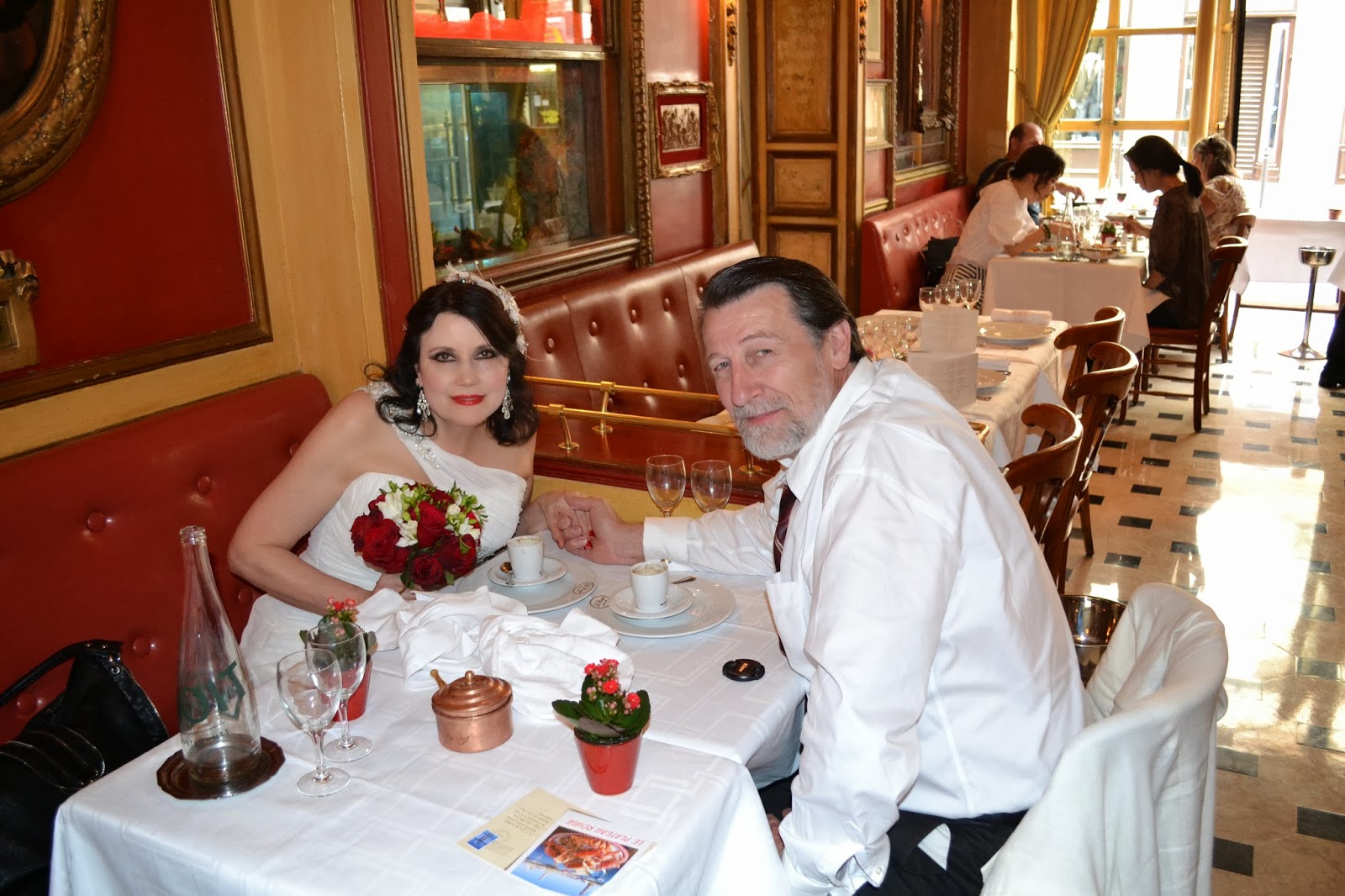
And here is my lovely bride in her "dress for one day".

As we walked the streets of Paris, young women asked again and again to have their photo taken with my lovely bride, assuming that we were newlyweds. I didn't correct them; I felt like we were, too.
Once, as I was standing to the side while yet another group of young women were having their photo taken with Karen for good luck, an older gentlemen nudged me in the ribs and said, "You have you a young, very pretty one there, don't you?"
As usual, folks assumed that I was a man of means who'd landed a "trophy wife". They couldn't know that this beautiful woman had done without many things for many years just to be with me and raise my children.
She's not a trophy; she's a treasure. My treasure.
Friday, June 21, 2013
(Seemingly Endless) Days of the Condor
My daughter Hillary is on vacation, visiting her sister Vinca in Virginia this week and asked me to write a guest post. So, while she views the monuments in D.C. and tromps the fields of Gettysburg, I will sit at my desk and slave away, dredging up old memories, just for her.
When I was younger, I worked in powerline construction; you know, those giant steel and cable behemoths that crisscross the country delivering massive amounts of electricity. In those days, we built EHV powerline mostly out on the great plains. It was an attempt by the government to connect the entire country on a grid and eliminate the plague of blackouts that were then occurring in the NE United States. (If you live in the NE and are old enough to remember those days, well, you're welcome.)
One of the most dangerous jobs in what was overall a very dangerous profession (the only professions with a higher mortality rate in those days were combat soldiers, astronauts, and race car drivers), was cutting in dead-ends. A dead-end is a structure constructed at a point where the line has to make a turn so sharp that it won't facilitate continuous conductor cable. The conductor must be cut at this juncture after it has been connected almost horizontally to the dead-end structure by strings of insulators (or bells, as we called them, because of how they look). Great loops of aluminum conductor are then slung beneath to connect up with the phase running off at a new tangent beyond the structure.
We all hated and dreaded cutting in dead-ends. It required the lineman to sit on the wire while maneuvering extremely heavy six-bolt stays onto the bundled conductor and attaching them by screwing them down hard onto the conductor with a torque wrench. The six-bolts would be fastened to the structure in order to keep the line under strain so that it would maintain its proper sag. Then the conductor would be cut between the six-bolts and the tower and the groundsmen would send up another extremely weighty hydraulic device called a press. With this, the lineman would press a sleeve with a ring on the end onto the conductor by which the conductor could then be permanently attached to the structure.
Sometimes the line would be lowered after it was cut (though kept under strain) and the pressing of the sleeve done on the ground, a much safer and easier method. Just as often, however, usually because of the configuration of the right-of-way, the pressing had to be done in the air.
All this while, the only thing holding millions of pounds of aluminum and steel in place was an operator's foot on the brake of an immense machine known as a puller. Oh, yes, there was an emergency brake, too, but this was a huge cumbersome thing and seldom used. Men in a hurry to build big things tend to cut the corners where they can. Besides that, our company's puller was an out-dated, even ancient thing, which we all suspected had been first built thousands of years ago and used up and worn out by the Romans or maybe even the Hittites.
I personally knew four men that died on the job in those years and two of those deaths occurred while cutting in dead-ends. Believe me, when tons of thick aluminum cable, held under tremendous strain, comes loose, it tends to ravel and twist as it recoils back up the line, seeking the drum from which it was unreeled. Gathering up the unfortunate lineman's remains for a funeral is a sad and often messy task.
Eventually, someone from OSHA came by and forced our company to come up with a better solution for cutting in dead-ends than simply hanging a lineman out there in perilous space where old man death could draw a good sharp bead on him.
The company's solution was to acquire another incredibly ancient Hittite machine - a high-lift truck capable of extending a bucket containing two men up to eighty feet in the air. The massive truck had once been called an Eagle by the manufacturer - we knew this because those of us with better eyesight could just make out the smudges of painted letters that had long ago faded into the metal.
The Eagle was a loathsome beast, contrary, undependable, dilapidated, and scary. Sometimes, as if on a whim, with two lineman stuck up there at the end of its fully extended boom, it would decide to re-adjust the pressure of its hydraulic fluid and drop its boom three or four or sometimes ten feet. You know, just for the hell of it.
Needless to say, this peculiar habit of the ancient animal made us all more than a bit skittish. (And caused us all to heap abuse upon the poor operator, who of course never had a clue as to why the machine acted like it did.)
We finally decided that it wasn't an "Eagle" at all, but something extinct or at least nearly extinct. So, we renamed it the "Condor".
Those of us on the clipping crews, responsible for permanently attaching the conductor to the structures, came to fear and despise the thing and our skittishness eventually devolved into terror. How we all hated to see a dead-end structure show up on the line!, especially if it might be our turn to take a ride in the Condor. That ancient beast became the stuff of my nightmares, and by the haggard, weary look of my comrades most mornings, I knew that it haunted their sleep as well. We even began to long for the old days, when we sat on the wire while we wrestled with six-bolts at dead-end structures.
One day, it fell to Wamsley and me to take our lives in our hands, ride up on the end of that worn-out, bouncing boom and cut in the dead-ends. It actually wasn't too bad that day, for the way that the truck was situated, the upper arm of the structure was right to our left, within reach, and most of the lattice-work mass of the lower half of the structure was directly beneath, fifty feet or so below our position, cutting off our view of the ground even further below where the ancient beast might seek to deposit us in rude manner at any second.
We had the six-bolts positioned on the wire and were working to secure them to the conductor when the Condor decided to have one of its moments.
Abruptly, the bucket dropped. I stared at Wamsley, wide-eyed, and he looked back at me in like manner. He was a lean, wiry fellow, with a tendency to squint, which made his eyes appear small. Usually, all one could see of Wamsley's eyes was only about half of his brown irises with little triangles of white to either side. This day, however, I could see all of his irises, plus a fair amount of white all the way around both of them. His eyes, I realized, were actually quite large when one got a really good view of 'em.
We expected the bucket to stop, as was its wont, but it kept going. In a fraction of a second, I realized that this was it - the machine had utterly failed and wouldn't stop until it, and we, were buried upon impact deep in the earth. Somehow, we had to get out.
Dead-end towers look rather like big X's, with the feet splayed out to hold the structure up and the arms, to which the conductor is attached, reaching up and out to either side. The upper part of the structure was just then passing by the bucket on my side. Instinctively, in a spasm of self-preservation, I leapt from the bucket, catching the lattice-work with my left hand. At the last instant, I thought of Wamsley and reached for him as I took my leap. His safety strap was hung over his shoulder and my fingers caught it, grasped it, and my hand formed a fist.
The bucket of the Condor continued to fall, finally grinding to a shuddering halt on the leg of the structure thirty or forty feet below.
There we were, seventy feet in the air; me hanging onto the steel lattice of the tower like grim death with my left hand, and Wamsley dangling at the end of his safety strap, suspended in space from my right.
He gazed up at me as he twisted slowly back and forth and his face grew sad. "We're all gonna die, you know. Sooner or later that damn thing will kill us all."
"I know," I replied through gritted teeth. "But not today."
We decided after that episode that the Condor wasn't a condor at all. I mean, there are still a few of those birds extant out in California - right? No, our beast was something more ancient still, something truly lost in the deeply layered age-old dust of history.
It occurred to us that it was, in fact, a pterodactyl. Truly extinct, a denizen of pre-history. So we re-named it. The Pterodactyl it was from that day forward. And still, though a member of a species that hasn't been seen on earth in many multi-millennia, it persisted in terrorizing us endlessly.
One day, I'd had enough. I went to the shop and found a can of black spray paint. After work, and after dark, when the crews had gone home, I hung around til the show-up yard was deserted and then I painted its new name up along the side of the boom. In great, bold letters.
Pterodactyl.
Later, when I became part of management, I understood that companies that construct powerlines have clients - the various power providers in the various states, and an image of professionalism must be maintained. Having your men deface company equipment, especially when that defacement can be construed as demeaning to the company, is really not a desirable thing. But at the time I did it, I didn't know this, and truthfully, might not have cared.
The next day, the general foreman of our crews, a huge man named Marlatt, found me where I was clipping in a phase up on a structure and yelled up at me, ordering me to the ground immediately. Now - dammit!
Once I was on earth, he proceeded to chew me up one side and down the other for defacing company equipment. He threatened to fire me. I believe he even threatened to kill me. I took it all as stoically as I could. Finally, he paused and asked me what I had to say for myself.
I struck as casual a pose as I could muster. "How do you know I did it?" I asked.
He went red (redder) in the face. "Cuz you're the only one of these lost souls with enough education to know how to spell a word like that. And it is spelled right - I checked."
My penance consisted of painting over my offense with white paint and even sprucing the old beast up a bit. It didn't matter. The guy from OSHA eventually came back around and ordered the thing off the job (our theory was that this particular inspector was actually thousands of years old and had first encountered our hapless machine in ancient Mesopotamia or perhaps the land of Uz). So, the Condor went away, its days finally over.
I seldom have nightmares these days about those days of the Condor - in fact, the nightmares may have stopped completely. I haven't had one now in, oh, I don't know, ..... four or five days.
Have fun in Virginia, Hoodoo.
Tuesday, April 16, 2013
Buck Up, Boy; It Isn't Normandy (guest post by Dad)
The first time my grandfather said those words to me, I must have been about eight years old and had no idea what the heck he was talking about.
Normandy?
What? - a place where everybody was named Norman? I didn't know.
Nor can I remember now what it was that was causing me to complain - okay, I was eight - whine. It must have seemed important, but then, at that age, everything is terrifically important, especially if it pokes at your young psyche in a negative way.
A couple of years later, I came to understand just what Normandy was all about. I studied the history of those horrifically lethal early morning hours of June 6, 1944, when a small stretch of Omaha Beach became the bloodiest piece of battlefield since Cannae.
And my grandfather's admonition came into sharp, clear perspective. He was right - I have never been subjected to the terrifying thump-thump-thump of a Krupp Arms 88mm that was aimed at me. I have never waded through pounding surf while strangers in bunkers on the clifftop above make every savage and desperate effort to end my life. I have never had to breath air that was more lead than air, while my friends and comrades are cut to pieces around me. I have never experienced the dark carnival of death.
No - whatever ailed me in those years of my youth - or anytime since - pales in comparison to that which far better men endured at Normandy. My life has been, as they say, a piece of cake.
Nevertheless, every life's road has its share of bumps and potholes. Becoming an adult, or even an older adult like myself, does not negate the opportunities for life to disappoint and dismay, or even dispirit one's soul. The only thing that changes is the substance of the disappointments. And the quality, of course.
Lately, I have experienced a fairly long string of disappointments. I am a self-published author that has been recently, and accurately, described as obscure; only a few hundred people know of my work. The story I tell is an epic heroic fantasy, quite long. When finished it will contain more than 900,000 words, about 520,000 of which are now in print. It is one long book, told in five volumes. The problem for the reader is that none of the books are episodic; nothing is resolved at the end. The story is linear, so the ending of one book simply leads into the beginning of the next.
As a consequence, most readers of fantasy are reluctant to get involved, knowing they will have to wait for the next installment. And the wait between the first three, which are out, and books four and five has been unbearably long, not just for the readers who have taken an interest in my work, but for me as well.
It takes time and money to produce a book. For the past couple of years, my family has been rocked by one difficulty after another - difficulties that inevitably steal away time and money. But since family is of incomparable more value than a book, I have willingly set the book aside time after time, and gone to see to more important things.
I admit, however, that at times I have been disheartened and dismayed. Even dispirited.
Buck up, I tell myself, again and again and again. After all, like my grandfather said - it isn't Normandy.
No, it certainly isn't.
It's just a book.
Daniel Hylton is the author of the Kelven's Riddle fantasy series.
Normandy?
What? - a place where everybody was named Norman? I didn't know.
Nor can I remember now what it was that was causing me to complain - okay, I was eight - whine. It must have seemed important, but then, at that age, everything is terrifically important, especially if it pokes at your young psyche in a negative way.
A couple of years later, I came to understand just what Normandy was all about. I studied the history of those horrifically lethal early morning hours of June 6, 1944, when a small stretch of Omaha Beach became the bloodiest piece of battlefield since Cannae.
And my grandfather's admonition came into sharp, clear perspective. He was right - I have never been subjected to the terrifying thump-thump-thump of a Krupp Arms 88mm that was aimed at me. I have never waded through pounding surf while strangers in bunkers on the clifftop above make every savage and desperate effort to end my life. I have never had to breath air that was more lead than air, while my friends and comrades are cut to pieces around me. I have never experienced the dark carnival of death.
No - whatever ailed me in those years of my youth - or anytime since - pales in comparison to that which far better men endured at Normandy. My life has been, as they say, a piece of cake.
Nevertheless, every life's road has its share of bumps and potholes. Becoming an adult, or even an older adult like myself, does not negate the opportunities for life to disappoint and dismay, or even dispirit one's soul. The only thing that changes is the substance of the disappointments. And the quality, of course.
Lately, I have experienced a fairly long string of disappointments. I am a self-published author that has been recently, and accurately, described as obscure; only a few hundred people know of my work. The story I tell is an epic heroic fantasy, quite long. When finished it will contain more than 900,000 words, about 520,000 of which are now in print. It is one long book, told in five volumes. The problem for the reader is that none of the books are episodic; nothing is resolved at the end. The story is linear, so the ending of one book simply leads into the beginning of the next.
As a consequence, most readers of fantasy are reluctant to get involved, knowing they will have to wait for the next installment. And the wait between the first three, which are out, and books four and five has been unbearably long, not just for the readers who have taken an interest in my work, but for me as well.
It takes time and money to produce a book. For the past couple of years, my family has been rocked by one difficulty after another - difficulties that inevitably steal away time and money. But since family is of incomparable more value than a book, I have willingly set the book aside time after time, and gone to see to more important things.
I admit, however, that at times I have been disheartened and dismayed. Even dispirited.
Buck up, I tell myself, again and again and again. After all, like my grandfather said - it isn't Normandy.
No, it certainly isn't.
It's just a book.
Daniel Hylton is the author of the Kelven's Riddle fantasy series.
Friday, October 19, 2012
The Longest Week of My Life
Since I am still recuperating and could literally burst into hysterical tears at any moment, my dad, author of the Kelven's Riddle fantasy series, agreed to share this story with my readers. It is about the year I was born, and he told it to me the other day to bring me out of my depression. It worked, because I suddenly realized there are worse trials than my broken ribs.
 |
| Dad way, way above the earth...on a power line pole |
In 1979, after a prolonged fiduciary illness, the economy of my home state of Idaho finally died, and in its dying throes it thrashed my own means of making a living completely out of existence. At the time, my wife Karen and I had three small children, and she was expecting our fourth.
We lost our house in the spring and our fairly new Chevy pick-up by summer. By fall, Karen and the kids were staying with her parents and I was bunking with my older brother in Boise, where both of us were trying to scrounge what work we could.
Do you know what desperation feels like? It feels like this: you know yourself to be utterly useless, for you have no way to house and feed your young family - and if you could, you would just shoot yourself, but that would only make things worse for those you love. So, you're stuck. Miserable and without hope, you stumble on.
Karen gave birth to our youngest on October 4. By then, opportunities for work had disappeared entirely, and I was back with my wife and children, living in a three-room house provided for us - to my shame - by my very kind father-in-law.
I couldn't afford a daily paper, so I took to walking across the street every morning to an elderly friend's house. John would make a pot of coffee, pour me a cup, and then go about his business of being discreet while allowing me to peruse his paper for job listings.
And one morning, there it was: a construction company needed people.
In Nebraska.
Nebraska! Hundreds of miles away, across the continental divide - which by this time was piling up snow in prodigious amounts. Nonetheless, after but a moment's hesitation, I called. Was I experienced in EHV power line construction? the voice on the other end of the line asked of me. Yes, I am, I lied. Well then, could I be in Ogallala, Nebraska by the following Monday? (This was Tuesday) Certainly, I stated, hoping I wasn't telling yet another whopper. Alright then, the voice said; come on - and when you get here, come to the office, ask for Richard.
Now, understand this: had there been a ray of hope coming from any quarter of the local map, I would never have considered trying to move my family across four states in winter. But I was desperate; my attempt at husband-hood and fatherhood was on the verge of abject failure. The horizon of our future was bleak and black.
We had no car, no money.
Karen suggested we sell everything we had that was sellable, which of course was nearly nothing. We managed to raise about thirty dollars. My older brother gave me a 1958 dodge which, he declared, would run if we could find a battery. My Dad found a battery, and lo!, the car did in fact, run. He also gave us another ten dollars, and my father-in-law, after failing to persuade Karen to remain behind while I went on alone, pitched in another twenty. So, we had sixty dollars.
I know that doesn't sound like much, but gas was much cheaper then, as was everything else. Relatives parted with what non-perishable and easily consumed foods they could spare, and we filled bottles with water. On a cold, blustery day, we loaded our three children, aged 1, 3, and 5, and our new baby into the ancient car and headed east. As a parting gift, my retired friend, John, bought us a tank of gas.
We slept that first night in a rest area south of Kemmerer, Wyoming. In the morning, after bathroom duties and a cold breakfast, we went on toward the continental divide as the sky lowered and snow began to fall. Just beyond Laramie, a flashing sign said: Interstate Closed. I went on anyway. Two miles further on, there was a gate across the road and a state trooper who informed me in tones that brooked no argument that I had to return to Laramie.
There, I parted with twenty precious dollars to buy a room to house my family for the night. The next day dawn cold and overcast, but without snowfall. The road opened mid-morning and I drove like a bat released from the nether regions to get across the mountain before the sky changed its mind.
Three days after leaving Idaho, we drove into Ogallala, Nebraska late in the afternoon. I checked my wallet. I had exactly fifteen dollars. We found a motel with efficiency kitchenettes and I went in to talk to the proprietor. "Twenty-five dollars a week," she said.
I drew a deep breath. "Do you know about the company building a power line here-abouts?"
"Yes, some of the workers stay with us."
"I have a job with them," I said. "I start in the morning - is there any way -?"
She cut me off rather sharply. "Is that your family in the car?"
"Yes."
She grabbed a coat and headed out the door. "I'll talk with your wife."
I blinked. "Yes, ma'am."
When she returned, her attitude had softened. "You can stay two weeks," she informed me. "If you have a job, you can catch me up from your first payday. If not, at the end of two weeks, you'll have to go."
"Thank you - God bless you!"
She watched me for a moment and then smiled slightly. "God bless you, too."
The next morning, I headed for the company's HQ on the outskirts of town. Upon entering the office, I found a slim, blond-haired man putting personal effects into a cardboard box. "I need to see Richard," I said.
"I'm Richard."
"Oh, good. I'm Dan Hylton from Idaho - you hired me last week."
He shrugged. "Well, I just got fired, so I'm sorry, but I can't help you."
I stared. Then, without realizing what I was doing, I crossed the room and grabbed him by his collar. "I just drove my family through a snowstorm to get here. You have to give me a job!"
He twisted loose. "Look - go out to the show-up, ask for Nevin, see if he's got a spot open. That's all I can do."
He gave me directions and I drove to the show-up yard. There were clumps of men standing around loading tools and equipment into trucks, getting ready to start their day. One man nearby had a dark braid hanging down his back. "Where can I find Nevin?" I asked.
He glanced around and then pointed. "That red truck over there."
Nevin turned out to be a small, weaselly-eyed man with thinning hair.
"Excuse me, sir, but I need a job."
He turned and examined me. I must have been a sight. Corduroy pants, simple, worn-out boots, shivering in my flannel shirt and light jacket. "Go to hell," he said.
My eyes widened. "What?"
He didn't answer, just closed the door and drove away, leaving me gaping after him. (Later, I became his boss, and he was forced to become accustomed to dealing with difficult assignments. I don't know if he remembered that first meeting, but I did.)
I stood there, my heart and mind as cold and numb as my fingers and toes. Desperation rose up out of the frozen earth and swallowed me whole. All this way to fail again! I was utterly hopeless. How could I face Karen?
There was a tap on my shoulder. "Hey, Buddy."
I turned. It was the slim man with the dark braid. He looked as tough as the icy ground we stood upon but his eyes were kind. "Need a job?"
I nodded. "Oh, yes."
He pointed. "See that blue truck over there. Go talk to that guy - his name is Chris."
With my heart in my boots, I stumbled over to the blue truck. Inside, talking on his radio, was the largest man I have ever seen or met. Seriously, were I a grizzly bear, I would avoid this guy's section of woods. He finished his conversation and turned to study me, looking me up and down.
"What are you?" He asked in a gruff voice that matched his behemoth-like looks.
I decided to answer in the same vein. "I'm an unemployed father of four - and I really need a job. Please. I'll do anything."
He grinned at my ragged appearance and the desperate tone in my voice. "You certainly look unemployed," he said. Then he pointed with a sausage-like finger. "See that guy with the braid? Go and tell him that you're on his crew. I'll come around later to do the paperwork."
"Thank you, sir!"
His grin faded. "Don't snivel - just get to work."
"Yes, sir."
The days were long and bitterly cold, but I took to the work as if I did indeed have experience. My first paycheck only covered a few days, but it was enough to bring the rent current, fill the cupboards with groceries, and buy me some serviceable work clothes. One week later, I cashed my second check and Karen and I just sat and stared at $440 spread out on the table. It was almost equal to what I had earned in a whole month at my last job.
I looked up and met my wife's lovely brown eyes. "Thank God," I said.
She smiled. "Yes, thank God."
A few years later, I was making a thousand dollars a week as a project engineer for that same company, and times were as good - financially - as they could be.
But I still can't think of that week, or indeed of the whole of 1979, without a cold shiver working its way up the length of my spine. Removed from the dark desperation of those times, I simply cannot imagine taking the risks that I took with my young wife and small children.
Thank God, indeed. It's true what my grandfather once told me about the Good Lord - He does, in fact, look after fools.
Friday, September 14, 2012
How I Found My Life (guest post by Dad)
Many, many moons ago when I was just a rotten teenager, I remember watching my dad trying to slick back his hair and comb his beard in preparation to pick up my mother from work. He examined the results in the mirror for a brief moment and asked me:
"Do I even remotely look good?"
I responded without thinking, "Yeah, sure - very remotely."
I didn't mean that the way it sounded. I meant to say, "Yes, very good", but I couldn't convince Dad of that. Still, he laughed good-naturedly, gave me a pat on the back for my home run sarcasm, and left to pick up his lovely lady.
But now, just look: these many years later when I am still rotten but no longer a teenager, it makes for an introduction of sorts to this tale of how he felt he was a dweeb's dweeb as a young man, but he still managed to meet my beautiful mother.
My mother always told me that I probably wouldn't marry before I turned thirty, I suppose because of the fact that I've always been disposed to deal with the exigencies of life in a pragmatic manner rather than a romantic one. In general, I was inclined to agree with her (I found teen-aged girls to be confusing, exasperating, and less interesting than a game of chess or even a good book).

"Do I even remotely look good?"
I responded without thinking, "Yeah, sure - very remotely."
I didn't mean that the way it sounded. I meant to say, "Yes, very good", but I couldn't convince Dad of that. Still, he laughed good-naturedly, gave me a pat on the back for my home run sarcasm, and left to pick up his lovely lady.
But now, just look: these many years later when I am still rotten but no longer a teenager, it makes for an introduction of sorts to this tale of how he felt he was a dweeb's dweeb as a young man, but he still managed to meet my beautiful mother.
My mother always told me that I probably wouldn't marry before I turned thirty, I suppose because of the fact that I've always been disposed to deal with the exigencies of life in a pragmatic manner rather than a romantic one. In general, I was inclined to agree with her (I found teen-aged girls to be confusing, exasperating, and less interesting than a game of chess or even a good book).
In the summer after I turned eighteen, however, I found myself living
alone. My parents were traveling in the
east with my younger sisters, my older brother was also in the east, at
college, and my eldest brother had long since finished college, moved away and
started his own life. I intended to work
for a year before going on to some sort of higher learning myself. So – there I was, alone, working six days a
week, maintaining a silent residence at night.
Now, I have always thrived on routine.
All that summer I went to work at seven every morning, got off precisely
at six every evening, and twenty minutes later was seated in my car at the
drive-in, ordering the same meal – hamburger w/ketchup, mustard, and pickles
only, medium fries, and a chocolate shake.
One evening, I pulled in and parked as usual. Before I could lean out the window and punch
the buzzer to order, I found my meal being delivered.
The girl shrugged. “The manager
says you always get the same thing at the same time, so why make you wait? Here it is.”
After she walked away, I looked down and considered my meal, and the
thought came into my head uninvited. I'm
far too young to be in a rut like this – I think I want a wife. Yes, that was it. No lightning bolt, no shock, no rumble of
thunder; just an abrupt urge to not be alone – and maybe get the chance to eat
a home-cooked meal again.
So, every evening for the next week or so, I went to the library and
read books on marriage. And women. Yes, I read books on sex, too. I mean, you never know, I might actually find
a wife and there were things I would need to know which, until now, I had been
disinclined to learn. My research taught
me, among other things, that for a young man of my disposition to find
contentment in the marital state, my ideal bride would be exactly seven inches
shorter than me – in other words, I needed to find about five feet, five and
one-half inches of woman. After thinking
about it, and as a purely personal preference, I also decided that I wanted her
to be a stunning beauty.
Armed with knowledge, I set off on my bride-finding search. First, I scoured churches, then hunted
through shopping malls, drive-ins, department stores – any place where a young
and unattached woman might work or frequent.
Despite the fact that many people, including myself, considered me to be
a total dweeb, I had surprising good luck.
Across the course of that summer, I dated twenty-five or thirty
different girls, aged sixteen-to-eighteen.
I discovered that all the girls that caught my fancy were invariably
pretty, fair-skinned, dark-haired, and dark-eyed. I also discovered, usually after just a
single date, that after catching my fancy, most of them did not hold it. In a couple of cases, I don't
know why the girl didn't interest me for the long term; she just didn't.
So, inevitably, I moved on. You
see, I wasn't looking for a fun time, but rather for a serious relationship
that would last a lifetime. Ultimately,
I set seventeen as an absolute minimum age (sixteen-year-olds would require too
long a wait). And I eventually had to
widen the scope of my search to take in distant towns and cities. As a result of my rapid movement through the
available young women in my region, I soon acquired a reputation as a
“wolf”. Now, seriously, you would be
hard-pressed to find anyone who is less of a ladies man than Yours Truly. Cary Grant, I am not. Even Cary Grant's ugly cousin, I am not.
Summer turned into autumn, autumn became winter. My nineteenth birthday approached.
The day came when my endeavors ground to a halt. You see, I was born and raised in one of the
least-populated regions of the nation, where the countryside is vast and towns
and cities are few and widely spaced.
The distances eventually became too great, and there were mountain
ranges or broad rivers between me and any new territory – as well as tons of
snow. I became despondent, for by now my
quest had become an urgent thing. I
really wanted a wife.
At the time, I was working with another young man who, if anything –
and sadly – was even dweebier than I was.
And he was just about the last person I thought would be on first name
basis with any eligible – or pretty – girls.
But I was desperate. We had been
carpooling and it was his turn to drive.
As I exited the car after work one night in January, I turned back and
looked at him.
“Carl,” I asked. “Do you know
any girls I could date?”
“Uh, yeah,” he replied diffidently.
“You know the Asher girls?”
I frowned at him. “Asher? Any relation to Jim and Art?”
“Yeah, their sisters.”
“They don't have sisters,” I protested.
“I know – I've been to their house a thousand times.”
Carl shrugged. “Yes, they do –
Karen and Stephie – younger sisters.”
Now this was interesting for two reasons, both of them connected to
Jim, the eldest of the two Asher brothers.
Art and I had been friends, working together in the orchards the previous
summer. He was a year older than me and
had gone into the Navy after graduation.
Jim, two years older than Art, had been in the Navy for three years now,
but had left behind a local legacy.
While Art was known as a tough guy, Jim – well, Jim was a Greek
god. Tall, golden-haired, well-built,
and handsome, he had broken every young female heart in the valley at one time
or another. To us younger guys, Jim was
everyone's elder brother, but to the girls?
He was more than Cary Grant – he was Dash Riprock. In fact, that's what we all called him.
His charm and irresistibility to females can be easily demonstrated by
a single incident.
One day, a few years earlier, I had been working in an orchard beyond
the outskirts of town. My old car had
refused to start and I was walking into town to get one of my older brothers,
both of whom knew more about cars than I did, to take me back out and try and
get the old beast going. A mile or so
from home, a car pulled up alongside and stopped. It was Dash.
He leaned out the driver-side window, his broad, handsome face lit up
with beautific smile.
“Hey, Danny – need a ride?”
I stared in disbelief. “Are you
kidding?”
I mean, besides Dash, there were 8-12 girls in that car, a '58 Chevy
two-door sedan. I couldn't get an
accurate count, for there were arms, legs, and pony-tailed heads protruding
from every one of the car's window.s.
The young ladies didn't seem to mind the crush of numerous rivals for
the object of their affection, so long as they could be close to Dash.
I pointed at the front of the car and laughed. “Should I ride on the hood?”
He glanced around. “I'm sure we
can get you in.”
“It's okay, Dash,” I said, shaking my head. “It's not far now.”
He shot me that dazzling smile.
“Suit yourself, kid. See you
later.”
So, my thinking (remember the two things?) when Carl told me of the
younger female Asher siblings went like this: If good looks like Jim's ran in
the family, at least one of Dash Riprock's sisters was bound to be very pretty. The second thing was that – as the girls were
his sisters – I wouldn't have to be in competition with him, a contest I would
lose on every level.
I looked at Carl. “You know
these girls?”
“Sure, I go to church with them.
I've been trying to date Karen for the longest time. If you could ask out Stephie, Karen might
agree to go along with me on a double date, 'cuz Stephie's too young to go out
alone.”
“Wait – how young is she?”
He considered. “Seventeen, I
think, or pretty close, anyway.”
“That's okay, I guess. When can we meet them?”
Carl brightened. “I'll set it
up.”
He did set it up, for the following Wednesday evening. When he came by to pick me up, however, his
mood was glum. He looked over at me with
downcast eyes. “Your reputation tripped
me up,” he stated accusingly.
“What do you mean?”
“You're something of a wolf, remember?
Well, Stephie's too scared to go out with you – so she wants to go out
with me. Anyway, Karen agreed to meet
you and see what she thinks.”
“How old is Karen?”
“Eighteen, I think – I'm not sure.”
“You wanna forget the whole thing?”
I asked.
His eyes went wide. “No – hell,
no! Any time I can get a girl to go out
with me, I'm not passing that up – and neither should you.”
I shrugged. “Alright – let's go
meet 'em.”
I had never met Jim and Art's parents despite having been at that house
several times in the past. Mr. Asher
turned out to be a handsome, suave, sophisticated, knowledgeable sort of
gentleman that I liked right away.
Basically, he was just an older version of Jim. Within minutes, we were talking politics,
local affairs, even global affairs. I
could tell that he liked me well enough, too.
Mrs. Asher was a sweet, gentle soul, dark-haired, very pretty.
After a while, Stephie came down the stairs and into the room. She was tall, slim, blonde, and pretty;
obviously Jim's sister in every respect.
Strangely, though, she did nothing for me.
She glanced doubtfully over at me, and then made for the couch where
Carl sat. “Hi, Carl,” she said brightly.
“Oh, well, hi,” he replied, blinking, trying to stand, failing
utterly. Evidently, dressed up and
dolled up, she did plenty for him that heretofore he hadn't noticed.
Mr. Asher turned to his wife.
“See what's keeping Karen, will you, dear?”
Mrs. Asher went over and called up the stairs. “Karen – your young man is here.”
A moment later, she descended the stairs, rounded the corner, and
entered the room.
I don't remember standing. I
mean, I always stand in the presence of ladies – I had stood earlier when
introduced to Mrs. Asher – but this time I was propelled upward as if by an
unseen, unknown, very powerful force.
Never had my eyes beheld such stunning, absolute, exquisite
beauty. Top to toe, from the soft, dark
hair that fell gently about her alabaster face, from her enormous, dark eyes,
perfect nose and rose-petal mouth to her delicate hands and feet, she looked
like God's finest, most perfect creation.
My bones abruptly assumed the consistency of over-cooked pasta. My heart caught its breath and held it, and
my brain froze.
“My daughter, Karen,” Mr. Asher said.
I tried to speak, but I doubt if it was a successful attempt. My mouth seemed to be filled with an
immovable wooden substance where my tongue should have been.
She tilted her head slightly, smiled and spoke. “I'm pleased to meet you.” Oh, what a marvelously sweet and pleasant
voice! When she spoke, it was like the
sound rendered by the lilting breezes of Spring as they move softly through the
branches of the willows along the gentle, sun-dappled waters of the
stream. Well, sure, I can wax poetic now. At the time, I must have appeared the
complete dolt, stupefied, unable to speak, or think, or even blink.
I do remember feeling utterly deflated.
She was so far out of my league that I might as well have been a Martian
stranded on Venus. For me to ask her out
would be like asking the Princess not only to kiss the frog but to do so with
the understanding that there was absolutely no chance he would ever turn
into a Prince.
Finally, Mr. Asher tired of my mute immobility. “So – are you kids going out Friday night?”
Astonishingly, Karen looked at me, smiled again, and said, “Sure.”
Are you kidding? I thought. I mean, you must know what you look
like – have you taken a really good look at me?
Well, we did go out. She even
sat close to me in the back of Carl's Thunderbird on the way over to
Boise. During the movie, the original Poseidon
Adventure, there's a scene where a man unexpectedly falls to his death into
burning oil. Startled, Karen jumped and
moved closer. Instinctively, I slipped
my arm around the back of her chair and found myself willing to sacrifice every
single actor on the screen. Let them die
horribly, if it meant that this lovely creature would turn to me for solace.
Crossing the parking lot after the show, I drew in a deep breath,
screwed up my courage, and reached down for her hand. As her fingers intertwined with mine fire
shot up the length of my arm and sent my heart racing. Forty years on, it still hasn't slowed down.
Seven months later, to my utter amazement, she agreed to marry me.
Here she is today, as beautiful as ever, tilting her head slightly as
she smiles at me and melts my heart.

Oh, yes, and by the way, she is exactly five feet, five and one-half
inches tall. Don't tell me research
doesn't pay off.
Subscribe to:
Posts (Atom)